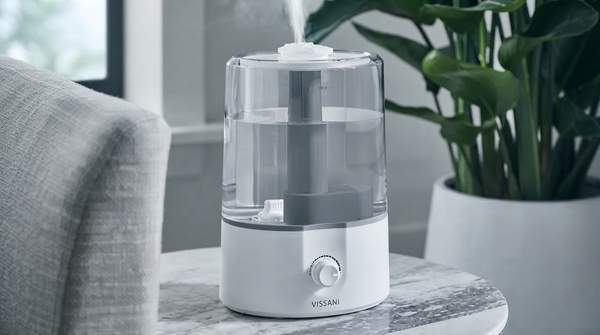
If quiet operation for a bedroom is your top priority, an ultrasonic humidifier is usually the best fit. If you want whole-house humidity without juggling multiple portable units, a whole-home system integrated with your furnace is the answer. And if you want to avoid the mineral dust that ultrasonic models can release when filled with tap water, an evaporative unit is the safer choice—provided you accept a fan's hum and regular wick replacements. The right pick depends less on feature lists and more on which trade-off you can genuinely live with, week after week.
Understanding Humidifier Types: Ultrasonic vs. Evaporative vs. Whole-Home
Portable cool-mist humidifiers come in two main varieties, and they work quite differently under the hood. According to humidifier expert Oram, quoted in CBC Life's buying guide, evaporative models "take water and evaporate it so it turns into water vapour — essentially humidifying drier air by passing it across a wet surface, such as a paper-based wick material." A buying guide from VeSync describes the same process more simply: these units pull air through a moistened wick filter using a fan and release water vapor back into your space. The fan is the defining feature—it does the work, but it also makes noise.
Ultrasonic humidifiers take a different approach entirely. Oram explains that they "project water droplets out of the machine using a nebulizer (a fast-vibrating disc that atomizes the water) or centrifugal atomizer." Instead of pushing air through a wet surface, a vibrating plate shatters water into a fine mist. Because there's no fan forcing air through a wick, these units run more quietly—but the droplets they release carry whatever is dissolved in the water, including the minerals that show up later as dust.
Whole-home humidifiers sit in a separate category. Rather than sitting on a nightstand, they attach to your HVAC system and humidify the entire house as the furnace blower circulates air, as VeSync's guide explains. Their noise is effectively the noise of your existing furnace fan, not a standalone appliance humming in the corner of your bedroom. That integration is both their greatest strength and their biggest constraint: they only make sense if you already have a forced-air system.
Prioritizing Your Needs: Noise, Coverage, and Maintenance
Before comparing specs, decide what matters most in your space. Achoo Allergy's buying guide stresses that matching capacity to your room is the critical first step: over-humidification can encourage mold growth, while an underpowered unit may fail to deliver noticeable benefits. In other words, a humidifier that's too big for the room is as much a problem as one that's too small. Get this step wrong and no amount of features will fix it.
For bedrooms and nurseries—spaces under about 400 square feet—VeSync's guide, drawing on recommendations from experts Lobdell and Rubino, suggests a 1-to-2-gallon tank and a noise rating below 30 decibels for sleeping areas. It also favors tabletop or portable designs that fit on nightstands, and units with night-light features for nurseries. The guide quotes Lobdell's practical advice: "Make sure when choosing a humidifier you find one that's easy to service," since maintenance accessibility matters most in rooms you use every night.
Finally, weigh how much upkeep you can realistically commit to before you buy, not after. Maintenance requirements vary widely between types, and ease of cleaning and filter replacement should be part of your decision from the start. Water quality and mineral control deserve a place on that same list, because they determine whether your humidifier releases clean moisture or something less pleasant along with it.