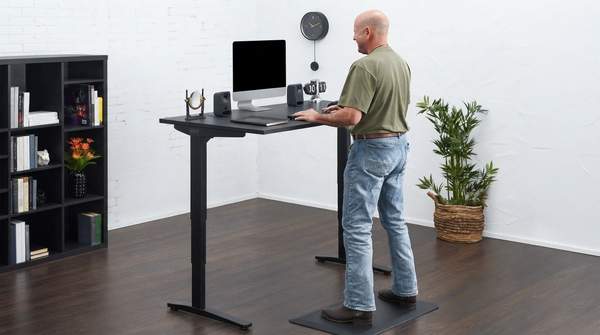
An effective standing desk mat reduces fatigue through two distinct ergonomic principles: absorbing the impact of standing on a hard floor and encouraging subtle, continuous muscle movements. Understanding how a mat’s material and surface design serve these functions is the key to choosing one that provides genuine, long-lasting comfort for your body and work style.
The Science of Standing Comfort
Standing for long periods on a hard surface can lead to discomfort and fatigue. Anti-fatigue mats are designed to counteract this, but their effectiveness goes beyond simple softness. The science of how they work points to two primary mechanisms: optimizing forces from the ground up and promoting instability to keep your muscles active.
The first mechanism involves managing the force that travels from the floor back into your body. According to a scientific review of studies on prolonged standing, a mat’s material properties are crucial. The research found that "absorption and transmission of ground reaction force during standing would be optimized, and the subjective comfort during prolonged standing would be improved when the material of the standing surface has greater elasticity, stiffness, and thickness." In essence, a well-designed mat acts as a shock absorber, dissipating the impact that would otherwise travel through your feet, legs, and back.
The second, and perhaps less intuitive, mechanism is the introduction of slight instability. A firm, flat floor allows your muscles to lock into a static posture, which can restrict blood flow and lead to soreness. An anti-fatigue mat’s soft, spongy surface creates a subtly unstable foundation, as explained by the workplace safety resource Ergo-Plus. This instability, though you may not consciously feel it, forces the muscles in your legs and core to make continuous micro-adjustments to maintain balance. These small movements stimulate circulation and prevent the static muscle load that causes fatigue.
From Foam to Foot Rests: Connecting Mat Features to Function
The ergonomic principles of force absorption and muscle activation are built into the physical characteristics of a mat. Its material composition determines its ability to cushion, while its surface design dictates how much it encourages you to move.
The core of any mat is its material, which provides the cushioning that absorbs impact. This is the same principle that makes jogging on grass more comfortable than on pavement. The key is finding the right balance of properties. Materials with appropriate elasticity, stiffness, and thickness create a supportive-yet-yielding surface that optimizes comfort. This is the primary function of traditional flat anti-fatigue mats.
More advanced mats incorporate a second ergonomic layer through their surface design. Instead of a simple flat top, these "active terrain" mats feature varied topography, such as bumps, ridges, and sloped edges. The Ergodriven Topo mat, for example, uses this type of raised terrain to encourage frequent posture changes. Other designs, like balance boards, take this concept further. The Trobing Standing Desk Mat Balance Board includes massaging beads and a built-in foot roller to stimulate circulation, while the Gymba Activation Board is designed to allow for diagonal, stair-stepper-like movements. These features are not just for novelty; they are engineered to promote the micro-movements that keep muscles engaged and blood flowing.