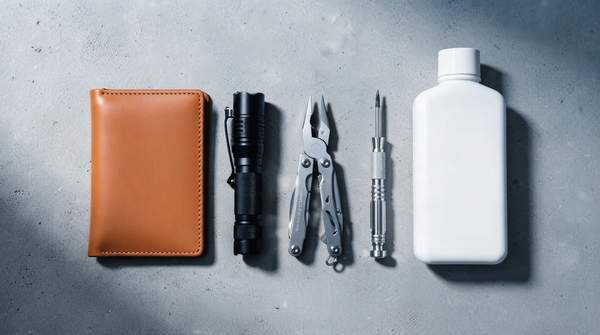
A minimalist everyday carry setup comes down to five categories—a cutting tool, a compact flashlight, a slim wallet or card holder, a key organizer, and optionally a multi-tool—and the real work is deciding, category by category, whether an item is compact enough, light enough, and multi-functional enough to earn its place in your pocket. That is a decision you can make systematically, and this article gives you the framework to do it, along with the material trade-offs that shape what each piece costs and how long it lasts.
Understanding Minimalist EDC Principles
Minimalist EDC is defined less by a specific item list and more by a discipline: everything you carry should have a purpose. The 2026 guide from Garage Built Gear, written by Matt Chambers, frames the payoff in practical terms—less pocket bulk, faster access, and gear that is easier to stick with long-term because every piece is intentional rather than accumulated.
The defining move is replacing single-use items with multi-functional alternatives. The Keyport guide to minimalist carry suggests swapping a separate flashlight, knife, and screwdriver for one compact multitool that combines all three, then using a modular key organizer that integrates keys with add-ons like a USB drive or small flashlight. CITYSHEEP's gear guide, authored by Mantas Tamošaitis, notes that the community minimum is narrow: three to five items covering the broadest range of daily needs—typically a phone, a slim wallet or card holder, keys on a compact organizer, and one cutting tool such as a small folding knife or Swiss Army Knife.
Your Minimalist EDC Decision Framework
Use the matrix below as a reusable evaluation tool. For each category, answer the selection questions against your own routine, then weigh the material column against your priorities—durability, weight, or budget. An item only earns a spot when it passes on all three dimensions: function, footprint, and material fit.
| Item Category | Primary Function | Key Selection Questions (Size, Weight, Multi-Functionality) | Material Considerations |
|---|---|---|---|
| Cutting tool | Daily cutting tasks | Does it fold to pocket size? Does it replace anything else you carry? Is it legal where you carry it? | Stainless blade steels; titanium or aluminum handle scales |
| Compact flashlight | Targeted illumination for everyday tasks | Is it small enough for a pocket or keychain? Does it duplicate what your phone already does? | Aluminum bodies are light and corrosion-resistant; titanium for premium strength-to-weight |
| Slim wallet or card holder | Carry cards and cash without pocket bulk | Does it force you to carry only what you need? Does it survive daily wear? | Leather, aluminum, or carbon fiber; carbon fiber sits at the premium ultralight end |
| Key organizer | Consolidate keys and small accessories | Does it eliminate key jangle and bulk? Can it integrate other tools (USB, light) to replace single-use items? | Aluminum or titanium bodies; modular platforms add functionality |
| Multi-tool | Combine pliers, screwdrivers, blades, openers | Does it replace two or more items you currently carry? Is the added weight offset by consolidation? | Stainless steel working parts; titanium or aluminum frames reduce weight |
The reasoning path is consistent: define the function you actually perform daily, test whether one item can absorb two or more of those functions, and only then compare materials. Tamošaitis's guide reports a proven community approach—start with just your phone, wallet, keys, and knife, then add one item per week while keeping only what you actually reach for, which prevents the accumulated "Batman tool belt" problem.
Cutting Tools: Balancing Utility and Size
The folding knife is the everyday standard, according to 381edc's gear guide: compact, pocket-friendly, and legal nearly everywhere. A fixed blade offers greater strength, faster deployment, and simpler maintenance, but at the cost of a larger carry footprint and stricter legal considerations in some areas—so check your local rules before choosing. The same guide recommends blade steels like 14C28N, 154CM, or Nitro-V for the best balance of sharpness, edge retention, and ease of maintenance for most people, while noting that premium steels such as M390 or MagnaCut deliver exceptional performance but cost more and demand more sharpening skill.
Illumination: Compact Flashlights for Everyday Tasks
The flashlight is where minimalists most often over-carry. The Garage Built Gear guide lists a compact flashlight among the core items but treats the multitool as optional depending on use—a signal that a dedicated light may be redundant if your phone or an integrated key organizer light covers your needs. The selection standard is straightforward: sufficient illumination for everyday tasks without excessive size. If a keychain-sized light handles the job, a larger dedicated torch is exactly the kind of "just in case" item the minimalist approach filters out.
Wallets and Key Organizers: Streamlining Essentials
These two categories do the quiet work of eliminating bulk. A slim wallet or card holder is on nearly every core list because it physically forces you to carry less. The key organizer goes further: the Keyport guide describes modular organizers that integrate keys with customizable tools—a USB drive, a flashlight, or small multitool functions—so the organizer itself becomes a consolidation platform rather than a simple keyring. High-quality construction matters here, the same guide notes, because these are the items handled dozens of times a day and wear shows fastest.
Multi-tools: Maximizing Functionality in a Small Footprint
The multi-tool is the category where the minimalist principle of multi-functionality is tested most directly. The test is not whether a multi-tool is impressive but whether it replaces two or more items you already carry—combining a knife, screwdriver, and bottle opener into one piece, as the Keyport guide puts it, reduces the number of items you need and keeps the setup efficient. If the functions it duplicates are functions you never actually use, the multi-tool itself becomes the dead weight. That is why some guides, including Garage Built Gear's, mark it optional rather than mandatory.
Material Matters: Trade-offs in EDC Gear
Material choice drives weight, durability, and price. Titanium is valued for its remarkable strength-to-weight ratio. Aluminum offers a lightweight, corrosion-resistant, and often budget-friendly option. Stainless steel provides durability. Carbon fiber is a premium, ultralight material known for its high strength-to-weight ratio.
Those shorthand labels rest on real engineering differences. Logical Carry's titanium explainer attributes titanium's premium reputation to its strength-to-weight ratio, corrosion resistance, and longevity, and its cost to two factors: the raw material is more expensive than aluminum or stainless steel, and it is significantly harder to machine—slower cutting speeds, specialized tooling, and longer manufacturing time. Notably, a titanium tool often mixes grades: an Urban EDC comparison by Yong-Soo Chung points out that Grade 5 titanium goes into structural components like framelock handle scales and pivot hardware, where strength-to-weight determines the design, while Grade 2 hardware handles lower-stress parts like clips and standoffs.
Aluminum, per FINTISO's handle-material guide, is a popular choice for knife handles because it is lightweight and corrosion-resistant with a good strength-to-weight ratio, and it can be anodized—though it is more prone to scratching and denting than alternatives. Carbon fiber, the same guide notes, offers immense tensile stiffness and a premium woven aesthetic suited to minimalist enthusiasts.
Building Your Intentional Carry
Readers should regularly review their EDC items, applying the decision framework to ensure each piece remains essential and aligned with their evolving daily needs. The measurable indicator of success is a streamlined pocket or bag with easily accessible, multi-functional items that are consistently used throughout the day—and, as Tamošaitis reports of experienced carriers, the pattern to expect is downsizing over time, not accumulation.
Sources
- Minimalist EDC Setup: Carry Less, Do More (2026 Guide) — Garage Built Gear
- The Minimalist’s Everyday Carry Guide: Essentials That Matter — Keyport
- EDC Essentials: The Complete Guide to Building Your Everyday Carry Kit — CITYSHEEP
- The Complete EDC Gear Guide | Build Your Loadout — 381edc
- Why Titanium Is One of the Best Materials for Everyday Carry? — Logical Carry
- Titanium Grade 2 vs. Grade 5 in EDC Gear — URBAN EDC®
- G10 vs. Aluminum vs. Carbon Fiber: Choosing the Best Handle Material f — FINTISO