If allergies have you shopping for an air purifier, the real decision isn't whether to buy one — it's how much cleaning power you need and how much noise you'll tolerate to get it. Drawing on expert testing from Consumer Reports, CNET's lab, and TechGearLab, three models stand out for allergy sufferers with very different personalities: the Coway Airmega ProX brings maximum muscle for huge spaces, the Blueair Blue Pure 311i+ Max balances strong cleaning with a discreet sound, and the Coway Airmega 400S clears particles fastest when you crank it up. Here's how they compare.
Top Air Purifiers for Allergies: Performance vs. Noise
Every air purifier lives with the same physics: faster fans move more air — and moving more air makes more sound. That's why Misha Kollontai, who oversees air purifier testing for Consumer Reports, puts it bluntly: "The best air purifiers can remove particles at any speed setting. The worst air purifiers will struggle even when running at the highest speed and produce a fair amount of noise."
For allergy sufferers, this trade-off matters more than for anyone else. Allergy relief depends on continuous operation — day and night, often in the bedroom — so a machine that only performs well on its loudest setting may never actually run at that setting while you're trying to sleep. The three models below handle that tension differently, and the right pick depends on your room size, the severity of your allergies, and your personal threshold for background hum.
A note on method: this comparison synthesizes published expert reviews and lab measurements rather than our own hands-on testing, and real-world performance can vary with room layout and pollutant levels.
Coway Airmega ProX: Maximum Power for Large Spaces
When raw cleaning capacity is the priority, nothing in this lineup matches the ProX. According to a detailed review published by Breathe Quality, its CADR ratings — the Clean Air Delivery Rate, which measures cubic feet of air cleaned per minute for a specific pollutant — come in at 586 for dust, 577 for smoke, and 450 for pollen, figures the review describes as placing it among the most powerful air purifiers in the world. That's a secondary source relaying manufacturer-adjacent specifications rather than an independent lab, but the numbers describe an enormous throughput relative to typical residential units.
The ProX achieves this through a dual-motor system built for Coway's largest residential unit, arranged in what the company calls a HyperCaptive dual-stack configuration. The specific filter media inside that stack — whether and how HEPA and activated carbon stages are arranged — isn't detailed in the available review material, so buyers wanting those specifics should check the manufacturer's documentation directly.
As for sound, the same review reports a noise level of 23 decibels, identical to the smaller Airmega 450. The catch is that the review doesn't specify which fan setting that measurement reflects — 23 dB is whisper-quiet, comparable to rustling leaves, but a dual-motor unit at full blast will almost certainly be louder. Treat the headline number as its quietest mode, not its everyday operating volume.
Blueair Blue Pure 311i+ Max: Balanced Performance and Quiet Operation
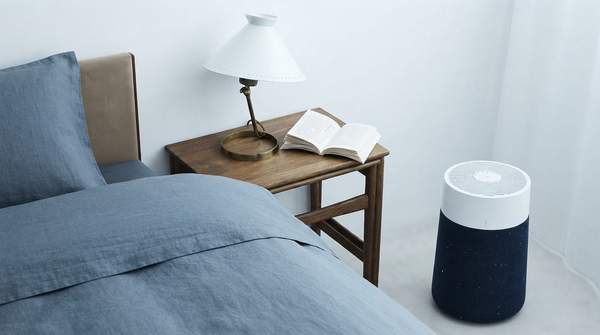
This is the compromiser's choice, and Consumer Reports' testers found a lot to like. On its higher settings, the 311i+ Max is "terrific at removing dust, pollen, and smoke, but expect a bit of noise," they note — while running it on low still delivers "near top-level results" with far more quiet. For an allergy sufferer, that's the ideal profile: strong cleaning you don't have to pay for in decibels during sleeping hours.
The machine's practical touches matter too. It has four speeds plus a dirt sensor that automatically kicks it into higher gear when particle levels rise, an indicator light for filter changes, app control, and a design intended for large spaces. Consumer Reports estimates annual maintenance at about $136.
One caveat worth knowing before you buy: TechGearLab, which scored a closely related Blueair unit, the Blue Pure 311i Max, as its best overall pick and praised its "rapid air cleaning" and "discreet sound," also lists "Not True HEPA filtration" among its cons. Blueair achieves its strong results with its own filtration technology rather than a certified True HEPA filter, so if the HEPA label is non-negotiable for you, that's a genuine consideration. TechGearLab's measurements for that 311i Max put it at 28 dBA on its lowest setting and 48 dBA on its highest — a 20-point spread that mirrors exactly the performance-versus-quiet dynamic Consumer Reports describes for the 311i+ Max.
Coway Airmega 400S: Rapid Particle Removal at High Speeds
CNET's lab testing crowned the Airmega 400S a test winner for the fastest fine-particle removal on high fan speed, noting that it did exceptionally well clearing both coarse and fine particles set to high "in both our previous and most recent lab tests." It also delivered the best overall particle-removal performance when all tests were averaged, which is why CNET calls it one of the most consistent units tested. Pollen and dust are exactly the coarse and fine particles that matter most to allergy sufferers, and its stated maximum coverage area of 3,285 square feet gives it room-filling range.
The noise picture sits between the other two models. CNET measured 39.36 dBA on the medium fan setting — a moderate hum, though that figure applies only to medium; noise will vary at other speeds, and its strengths emerge at high speed, where fan noise inevitably rises. It's also, per CNET's pricing note, an investment at $499.
Comparative Overview of Top Allergy Air Purifiers
Set side by side, the three models sort cleanly by priority. The ProX wins on headline cleaning capacity, the 311i+ Max on quiet usable performance, and the 400S on lab-verified speed at high speed.
| Model | Filtration performance (dust/smoke/pollen) | Filter system | Noise level | Best for |
|---|---|---|---|---|
| Coway Airmega ProX | CADR of 586 dust / 577 smoke / 450 pollen (cfm), per a Breathe Quality review — among the most powerful reported | HyperCaptive dual-stack, dual-motor configuration; specific filter media not detailed in available reviews | 23 dB reported; fan setting not specified, so treat as its quietest mode | Very large spaces where maximum cleaning power outranks everything else |
| Blueair Blue Pure 311i+ Max | Removes dust, pollen, and smoke terrifically on high; near top-level results on low, per Consumer Reports | Blueair's own filtration technology — not True HEPA, per TechGearLab's notes on the related 311i Max | 28 dBA on low to 48 dBA on high (measured on the 311i Max) | Balanced cleaning and quiet, especially bedrooms and living areas |
| Coway Airmega 400S | Best overall particle removal averaged across tests; fastest fine-particle removal on high, per CNET lab testing | Not detailed in the cited passages | 39.36 dBA on medium fan; varies at other speeds | Rapid particle clearing when high-speed running is acceptable; up to 3,285 sq. ft. coverage |
Read the table with the trade-off in mind: the ProX's staggering CADR comes from a dual-motor machine you'll want to run on lower speeds most of the time; the 400S earns its laurels specifically at high speed; and the Blueair is the only one of the three whose reviewers explicitly praise its low-setting performance as near the top.
Making Your Choice: Balancing Clean Air and Quiet Comfort
The decision framework is straightforward. Choose an air purifier by prioritizing either maximum air cleaning performance for larger or more polluted spaces — that's the ProX, with the highest CADR figures — or quieter operation for bedrooms and living areas, where the 311i+ Max's near top-level low-speed results make it the natural fit. If your pattern is running the machine hard during the day to knock down pollen fast, CNET's testing says the 400S is the speed champion at high fan speed. And weigh the filter question: Blueair's non-HEPA approach performs strongly in testing but skips the certified True HEPA label, while a certified HEPA filter, as Consumer Reports notes, is rated to capture at least 99.97 percent of particles 0.3 micron or larger — the standard many allergy sufferers look for first.
Remember that these machines are designed to run continuously, so the noise level you'll live with is the one at the speed you actually use. The measurable indicator of a good choice: the purifier you select effectively reduces your allergy symptoms and operates at a noise level you find acceptable in the intended room, confirmed by your own experience and consistent air quality over time. Run it for a few weeks during your worst allergy season — if you're sleeping through it and noticing fewer symptoms, you picked the right trade-off.