There is no single best bristle material for an electric toothbrush head—there are only trade-offs, and they map cleanly onto three priorities. Nylon offers the most flexibility and a gentler feel on gums; polyester (PBT/PET) filaments are cheaper, more durable, and absorb less water; bio-based filaments reduce dependence on fossil feedstocks but do not, by themselves, make a brush head biodegradable or an electric toothbrush environmentally benign. A narrative review of powered toothbrush design published in the scientific literature puts the choice plainly: which material is "better" in cleaning efficacy "actually depends on one's choice," which is why manufacturers increasingly blend the two polymers in a single head.
Understanding Electric Toothbrush Bristle Materials
Most electric toothbrush heads rely on synthetic polymer filaments, and the two workhorses are nylon and polyester—specifically the thermoplastics PBT and PET. The materials differ in ways a consumer can actually feel: nylon bends more readily, while polyester resists the splaying and water uptake that degrade a head over its working life. A third category, bio-based filaments, is chemically similar to conventional synthetics but derives partly or entirely from renewable biological resources rather than fossil fuels; Perlon's Medex S GreenLine dental-care filament range is one example cited in industry guidance for brush head buyers. Notably, this article does not address silicone or charcoal-infused bristles, which fall outside the evidence base here.
Nylon Bristles: Flexibility and Common Use
Nylon is the most common bristle material in electric toothbrush heads, and its defining virtue is flexibility. A more compliant filament conforms to the contours of teeth and, crucially, to gum tissue, which is why the design literature treats nylon's flexibility as favorable to the gums. That same compliance has a cost: nylon absorbs more water than polyester, and repeated bending eventually leaves its mark as frayed, splayed tips. Flexibility also interacts with abrasion in ways that are not purely material-driven. An in vitro dentin abrasion study published in PLOS One notes research showing that thinner, more densely packed filaments retain more toothpaste, flex more readily, and produce greater surface contact—increasing abrasivity—so a soft-feeling nylon head is not automatically a low-abrasion head.
Polyester (PBT/PET) Bristles: Durability and Water Resistance
Polyester bristles invert the trade-off. According to the toothbrush design review, PBT and PET are cheaper, more durable, and less water-absorbent than nylon—properties that translate into a longer usable life, better hygiene between replacements, and less of the fraying that Oral-B, describing its own heads, says its bristles resist "between replacement times." The catch is stiffness: a stiffer filament is less forgiving on gum tissue. Designers have answered with tapered polyester bristles—needle-shaped filaments with lowered stiffness that the review describes as "more favorable to the gum." In other words, polyester's disadvantage is engineering-addressable, which is one reason mixed nylon-polyester heads exist.
Bio-Based Filaments: The Environmental Choice
Bio-based bristles are synthetic filaments made partly or entirely from renewable biological resources, and industry guidance for brands stresses that choosing one is "only the starting point"—the material must still meet requirements for brushing feel, bristle retention, durability, and cost. Two distinctions matter for consumers. First, bio-based does not mean biodegradable: renewable feedstock content and end-of-life behavior are separate questions, and a supplier's "100% bio-based" filament statement does not make the complete head 100% bio-based, since housings and internal components may remain conventional. Second, bristles are a small part of an electric toothbrush's footprint. A 2020 life-cycle assessment in the British Dental Journal, cited by the sustainable toothbrush maker Kaylaan, found electric toothbrushes carry the worst overall environmental footprint of any toothbrush type, driven by batteries and electronics rather than bristle or housing material.
Beyond Material: Design Factors Affecting Performance
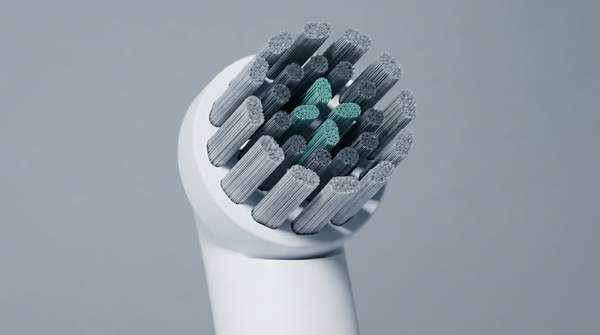
Material is only half the story. Industry guidance on evaluating brush heads instructs buyers to assess the filament together with the completed tuft configuration: filament diameter, tuft density and height, trim profile, bending resistance, recovery after repeated bending, and resistance to permanent splaying. Swapping a conventional 0.15 mm nylon bristle for a 0.15 mm bio-based filament, for example, may still require adjustments to hit the target feel. Brand guidance echoes the point from the consumer side: Oral-B attributes its heads' gentle clean for sensitive gums to higher bristle density and to bristles "specifically and expertly placed to deliver optimal cleaning performance." The PLOS One abrasion study reinforces that geometry and density can matter as much as polymer chemistry. A cheap head with well-designed tufts can outperform a premium material in a poorly configured head.
Electric Toothbrush Bristle Material Comparison
The table below maps each material's physical properties to the user priority it serves best, synthesizing the design review, industry guidance, and the life-cycle assessment discussed above.
| Material Type | Key Advantage | Primary Trade-off | Best For (User Priority) |
|---|---|---|---|
| Nylon | Superior flexibility, giving a gentle, gum-friendly feel | Higher water absorption and less durability; not biodegradable, contributing to plastic waste | Gum comfort and a flexible brushing experience |
| Polyester (PBT/PET) | Cheaper, more durable, and less water-absorbent; resists splaying and fraying | Stiffer than nylon, though tapered designs lower stiffness for gum comfort | Maximum bristle durability and hygiene between replacements |
| Bio-based filaments | Partly or wholly derived from renewable biological resources instead of fossil feedstocks | Not necessarily biodegradable; performance must be validated against the full tuft configuration, and the handle and electronics dominate the brush's footprint | Reduced fossil-fuel dependence, with realistic expectations about overall impact |
Read the table as a decision aid, not a ranking. If your gums bleed or you find brushing uncomfortable, flexibility points to nylon or a tapered polyester. If you replace heads reluctantly and want bristles that hold their shape, polyester's durability wins. If renewable feedstocks matter to you, bio-based filaments deliver that specific benefit—provided you check what the claim actually covers.
Making Your Choice: Balancing Priorities
Because the design review declines to crown a winner—cleaning efficacy "depends on one's choice"—the practical move is to match material to your dominant concern, then judge the specific head on its design. Check whether a "bio-based" claim covers all tufts or only some, per the ISO 16620-2 guidance on biobased carbon content, which should not be conflated with the bio-based mass percentage of the complete head. And remember that the environmental weight of an electric toothbrush sits mainly in its battery and electronics, so a replaceable-head design matters more than bristle chemistry if footprint is your priority.
Choosing Your Bristle Material: A Personalized Decision
Select an electric toothbrush head material by aligning its properties with your primary oral care priorities, considering gum comfort, bristle durability, and environmental impact. The measurable indicator of success: the reader will be able to articulate the specific trade-offs of nylon, polyester, and bio-based bristles and identify which material best suits their individual needs. If you can say why nylon's flexibility suits sensitive gums, why polyester's low water absorption extends head life, and why a bio-based label is a feedstock claim rather than a biodegradability guarantee, you have everything needed to make the choice at the shelf.
Sources
- Safety and Design Aspects of Powered Toothbrush—A Narrative Review - PMC
- Bio-Based Bristles in Electric Toothbrush Heads — Uoralcare
- An in vitro study on dentin abrasion comparing two sonic toothbrushes with… — Journals
- Oral-B Replacement Toothbrush Heads: Benefits & Differences
- Do Electric Toothbrushes Release Microplastics? — Kaylaan LLC