Picture a cyclist passing through a stretch of mountain road. A camera mounted at chest height captures the handlebars and the bends ahead, while a camera positioned near the ground could make the same movement appear faster and more dramatic. Neither perspective changes the ride, but each tells a different visual story.
That difference begins long before anyone presses record. Camera placement, mounting choices and exposure settings influence what the audience eventually sees, sometimes as dramatically as the camera itself.
For photographers and video enthusiasts exploring these possibilities, zarnayhtoo offers several camera accessories that address different aspects of shooting. Its catalogue includes a flexible action-camera clamp, a magnetic quick-release accessory listed for the Insta360 Ace Pro and an ND8-style camera filter.
The Camera’s Position Changes the Story
A camera records whatever appears within its field of view, but positioning determines how that view feels. Mounting a camera low can emphasise movement across the ground, while placing it above a work surface gives a better view of someone’s hands and the activity taking place.
A conventional eye-level recording often feels familiar because it resembles everyday human vision. Moving the camera somewhere unexpected introduces a perspective that people rarely experience directly, which can turn even a routine activity into something visually interesting.
Consider filming someone preparing a meal. A camera facing the person captures expressions and conversation, while an overhead camera reveals the arrangement of ingredients, utensils and movements across the counter. The activity remains unchanged, yet the two recordings communicate different information.
One product in zarnayhtoo’s assortment is the NNEIDS Flexible Clamp Mount for Action Cameras. Its clamp-based design offers a different mounting concept from holding a camera or attaching it to a conventional tripod.
The attraction of a clamp mount is the possibility of securing a camera to an appropriate surface or structure, making certain fixed viewpoints easier to maintain. The specific surfaces, camera connections and loads it can accommodate depend on the actual mount design, but the creative possibilities are readily apparent.
An overhead view might make a tabletop demonstration easier to follow. A lower position near a stationary bicycle could concentrate attention on its mechanical details, while a side-mounted camera at a suitable fixed location might capture action moving through the frame.
The position is not merely a technical detail. It determines which objects dominate the foreground, how much background remains visible and what the audience notices first.
Movement Looks Different From Every Angle
Camera placement also changes the apparent speed of movement. An object passing close to a lens can sweep dramatically across the frame, while the same object filmed from farther away may appear to move more slowly.
Imagine filming a skateboarder performing a trick. A low viewpoint beside the action draws attention to the wheels, board and pavement, while a wider elevated view shows the skater’s full movement and the surrounding space.
Those perspectives can work together in an edited sequence. A wide shot establishes the location, a closer shot reveals the defining action and an unusual angle supplies a moment that might otherwise go unnoticed.
This approach applies equally to quieter subjects. A gardening video could move between a wide view of the garden, an overhead view of seedlings and a close-up of hands working the soil.
The images are connected by the activity, but each reveals something different. The variety gives an editor material to build a sequence rather than relying on one uninterrupted viewpoint.
A flexible mounting arrangement becomes interesting here because certain scenes benefit from leaving the camera in a fixed position while the action continues. That frees the composition from the natural movement of a handheld camera, provided the mount can be secured appropriately.
The strongest creative reason to use an accessory is therefore often visible in the footage itself. The audience sees an angle that helps tell the story, without needing to know how the camera was positioned.
Quick Releases Change the Rhythm of Shooting
Finding an interesting viewpoint is one challenge. Moving between camera setups introduces another.
Suppose someone is filming a day outdoors and wants a fixed view of a campsite, followed by a handheld walk through the area and a closer recording of the cooking setup. Each scene calls for a different relationship between the camera and its support.
Traditional mounting arrangements can involve loosening fasteners, detaching equipment and securing everything again. Quick-release systems are intended to reduce some of those repeated steps, although their actual attachment mechanisms vary.
zarnayhtoo lists an NNEIDS Amagisn Magnetic Quick Release for the Insta360 Ace Pro Sports Camera. Its product name identifies a specific camera family and a mounting accessory intended for changing configurations.
Magnetic quick-release systems commonly use magnetic alignment together with a mechanical securing arrangement. For example, Insta360’s own Ace Pro mounting system uses a magnetic design with a positive attachment mechanism, demonstrating why a secure connection involves more than magnetic attraction.
The appeal becomes apparent during a recording session with several planned shots. Instead of treating every camera move as an interruption, the operator can organise the sequence around the perspectives each scene needs.
That does not mean all magnetic mounts can be used interchangeably, or that every quick release is appropriate for high-impact activities. The accessory’s actual connection, compatibility and intended operating conditions determine where it can be used safely.
For controlled filming situations, however, changing between suitable mounting arrangements can make a multi-angle project easier to manage. The camera can move with the story rather than remaining committed to one position.
Light Determines How Motion Appears
Positioning influences what enters the frame. Exposure controls influence how movement within that frame is recorded.
Bright sunlight creates particular challenges for video because obtaining a suitable exposure can conflict with the shutter speed chosen to portray motion. On cameras with limited aperture control, the available options may become more restrictive.
A fast shutter captures a relatively brief interval of movement, producing sharper individual frames. A slower shutter records movement over a longer interval, allowing motion blur to develop.
Think of a bicycle wheel turning quickly. A sufficiently fast shutter may preserve individual spokes, while a slower shutter can allow them to blur together, strengthening the impression of rotation.
Neither treatment is automatically preferable. The desired appearance depends on whether the filmmaker wants to examine the movement closely or portray it with a smoother visual rhythm.
A neutral-density filter helps manage that relationship by reducing the amount of light reaching the camera’s sensor. It allows exposure settings that might otherwise admit too much light under bright conditions.
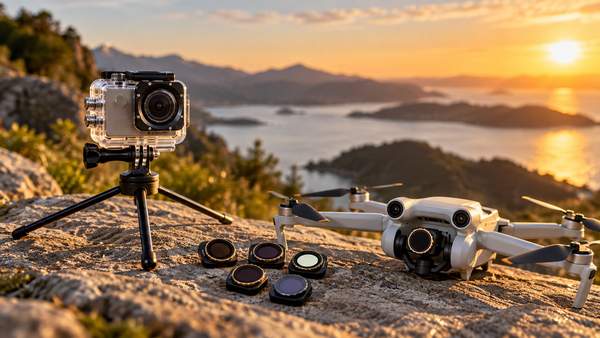
Among zarnayhtoo’s products is the NNEIDS Pro Mini 3 Camera Filters — ND8 Style listing. ND8 is a recognised neutral-density designation corresponding to a reduction of three exposure stops, allowing approximately one-eighth of the original light to pass through.
This can be especially interesting when filming flowing water, traffic or other subjects whose appearance changes with shutter speed. A waterfall recorded with a fast shutter may reveal distinct droplets, while a slower shutter can soften the appearance of the moving water.
The same principle influences video, where the relationship between frame rate and shutter speed affects the appearance of movement from one frame to the next. Neutral-density filters give filmmakers another way to manage that relationship without relying solely on changes to other exposure settings.
Unlike a clamp or quick-release mount, a filter does not change the viewpoint. It changes the light available for recording, which makes it a different kind of creative accessory.
The Pro Mini 3 filter listing also belongs to a different camera category from the Insta360 Ace Pro accessory. Their appearance in the same catalogue does not mean the products fit the same camera or work together as a single system.
Planning the Shot Before Setting Up the Camera
A short outdoor film offers a useful way to see how these decisions can work together. Imagine a sequence showing someone arriving at a lakeside campsite, unpacking equipment and watching the light change across the water.
The opening might use a wide view that establishes the surroundings. A fixed camera position could then record hands arranging equipment, followed by a closer shot of an object being placed on the ground.
If the operator is using a compatible quick-release system, moving between suitable supports may simplify the transition between those setups. Later, an appropriate ND filter could help manage exposure while recording the movement of water in bright conditions.
Each decision serves a different purpose. Position establishes perspective, mounting arrangements affect how the camera is handled and light control influences the appearance of motion.
The result is not automatically professional footage. Composition, timing, subject movement and editing still require deliberate choices, and accessories cannot substitute for observing what makes a scene interesting.
They can, however, expand the practical options available to someone pursuing a particular image. An unusual viewpoint may become easier to capture, a sequence may involve fewer attachment steps or a desired shutter speed may become more practical in bright light.
Those possibilities give the camera-accessory listings at zarnayhtoo a meaningful connection to the process of making images. Its flexible clamp, magnetic quick release and ND8-style filter address different decisions that photographers and video enthusiasts encounter.
The Next Shot Begins With an Idea
A memorable recording often comes from a small decision made before filming: placing the lens closer to the action, finding an unexpected viewpoint or letting movement appear naturally through the frame.
Explore zarnayhtoo’s camera accessories for equipment suited to those different creative tasks. The most interesting question is what you want the next shot to show.