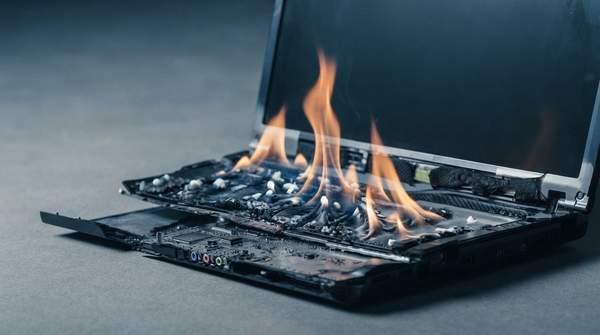
Laptop battery fires are rare, but they share a single underlying mechanism: a self-accelerating overheating process called thermal runaway. Preventing it comes down to three things—how you charge, where you store the machine, and the physical condition of the battery and charger. Once you understand what actually happens inside a failing battery, the safety rules stop feeling like arbitrary habits and start making sense.
Understanding Thermal Runaway: The Core Risk
The U.S. Department of Energy's Office of Science describes the process plainly. A short circuit inside a battery cell can trigger thermal runaway, "whereby the increase in temperature of the cell accelerates the chemical reaction, adding to the heat in turn and leading to the combustion of battery materials." In other words, heat makes the chemistry inside the battery faster, and that faster chemistry produces still more heat. The loop feeds itself.
Worse, the failure doesn't stay contained. The Energy Department notes that such a failure "can trigger a chain reaction whereby successive cells in the battery burst into ever hotter flames." A laptop battery is a package of many individual cells, so one compromised cell can set off its neighbors in sequence. Indiana University's Office of Insurance and Claims Administration, which publishes life-safety procedures for laptop and battery hazards, warns that lithium-ion batteries in laptops can catch fire, explode, or release toxic fumes from burning plastics once they enter thermal runaway—which is why the university treats them as a serious fire risk when they overheat or become damaged.
What starts the loop? The Energy Department identifies three triggers: mechanical injury to the battery, overcharging, or overheating from an external source. A drop that dents the case can create the internal short circuit; a charger that keeps pushing current after the battery is full, or a laptop left baking in a hot car, supplies the heat that gets the reaction going. Overcharging is a particular concern with chargers that don't stop on their own—OSHA's workplace safety guidance on lithium batteries notes that some batteries will overcharge if a charger is used that does not turn off when the battery is fully charged.
Two points of reassurance are worth stating. First, these fires are not spontaneous: something—damage, heat, or bad charging—sets them off. Second, the warning signs usually arrive before the flames do. The same triggers that cause thermal runaway are also the signals you can watch for, which is where the checklist below comes in. If a fire does start despite your precautions, Indiana University's guidance is unambiguous: call 911 immediately and treat a burning laptop as a real fire emergency.