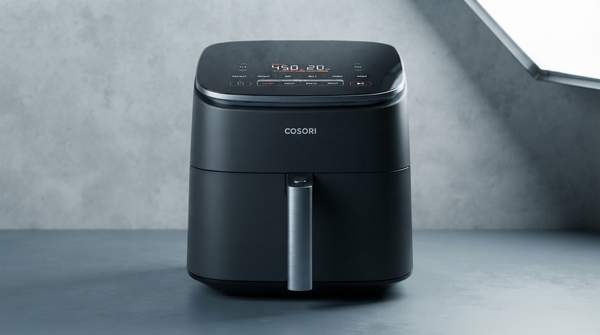
If you're choosing an air fryer in the 6-quart class, the practical decision comes down to three things: how many people you cook for, how fast you want food crisped, and how much friction you'll tolerate at cleanup time. I compared the specifications and usability notes published for three widely recommended models, the COSORI TurboBlaze 6.0-Quart, the Cuisinart Six-Quart Air Fryer, and the Instant Pot Vortex Plus 6QT XL, to show how those numbers translate into daily cooking.
Before the details, one honest caveat: this is a comparison built from published specifications and reviewer reporting, not new hands-on testing. It covers a selection of popular models, not the whole market, and I've left pricing out because it varies widely by retailer and date.
Air Fryer Comparison Table
Here are the three models side by side across the criteria that matter most. Where a source didn't report a figure, I've said so rather than guessing, because a blank cell is a genuine gap in the reporting rather than proof a feature is missing.
| Model | Capacity (Quarts) | Wattage | Key Functions/Presets | Cleaning |
|---|---|---|---|---|
| COSORI TurboBlaze 6.0-Quart | 6.0 quarts | Not reported in the sources reviewed | Nine functions: Air Fry, Roast, Bake, Broil, Dehydrate, Frozen, Proof, Reheat, Keep Warm (manufacturer listing) | Manufacturer advises warm water, mild soap and a non-abrasive sponge for the basket and crisper plate |
| Cuisinart Six-Quart Air Fryer | 6 quarts | Not reported in the sources reviewed | Ten presets including French Fries, Wings, Vegetables and Leftovers (Food Network review) | Not reported in the sources reviewed |
| Instant Pot Vortex Plus 6QT XL | 6 quarts | 1,700 watts (reported by Pacific Street Pizza Co.) | Six cooking functions (reported by the same review) | Non-stick basket reported to ease cleanup; stainless exterior may show fingerprints |
The comparison reveals a real trade-off pattern. All three sit in the same 6-quart capacity class, so the differences that matter are in function count and convenience: COSORI stacks nine functions including Proof and Dehydrate, Cuisinart offers ten one-touch presets tuned to specific foods plus a viewing window, and the Vortex Plus pairs six functions with a reported 1,700 watts and a non-stick basket. Capacity alone doesn't separate these machines, which is exactly why the next section matters.
Decoding the Specs: Capacity and Wattage for Your Household
A wattage guide published by Francois Servranckx on Green Gooding lays out a useful size-to-power mapping. Small air fryers at 2 quarts or less typically run 800 to 1,300 watts and suit a solo cook making side dishes and snacks. Medium units at 3 to 6 quarts generally draw 1,400 to 1,800 watts, enough for a couple or small family cooking full dinner sides. Large or dual-basket models at 8 to 12 quarts run 1,800 to 2,000 watts and are aimed at group cooking, holiday meals and batch wings.
The same guide argues that for one or two people in a small apartment, a 4-to-6-quart unit at 1,500 to 1,700 watts is the sweet spot: powerful enough to crisp food quickly, but small enough to fit on a counter without monopolizing the outlet. That maps neatly onto the three models above, which all land in that medium tier, and onto the reported 1,700 watts of the Vortex Plus, squarely inside the recommended range for its capacity.
What this means for you: if you regularly cook for four or more, a 6-quart basket is the sensible floor, and pushing toward the 8-to-12-quart tier, with its 1,800-to-2,000-watt power draw, is what enables genuine batch cooking. If you're cooking for one or two, a 6-quart model still works but you're carrying extra counter footprint, and a smaller, lower-wattage unit would do the same jobs. One caution I want to be clear about: I found no independent test data linking a 200-to-300-watt difference at equal capacity to specific cooking-time or crispiness outcomes, so treat wattage within a tier as a rough proxy for heating power, not a guaranteed speed figure.
The COSORI listing adds one performance claim worth noting: the TurboBlaze, with standard DC motors, is advertised as cooking "up to 46% faster than the old COSORI series." That's a manufacturer comparison against its own prior lineup, not an independent benchmark against the other two machines, and the claim is asterisked to a different figure entirely, 95% less oil than deep frying, with fat content analyzed by an SGS lab. Read the speed number as marketing context, not a tested result.
Beyond the Basics: Essential Cleaning and Convenience Features
Cleaning is where a daily appliance earns or loses its place on your counter. COSORI's own product guidance is specific: clean the basket and crisper plate with warm water, mild soap and a non-abrasive sponge, and for larger amounts of food, 1.5 pounds or more, flip or shake the food halfway through cooking for the best results. Preheating isn't always required but, the manufacturer notes, may improve consistency for certain recipes.
The Cuisinart's standout convenience feature is visibility. Food Network's tested review, by T.K. Brady, calls the Six-Quart its top pick for people who like to watch their food cook, thanks to a see-through window that makes checking progress easy. The trade-off, per the same review: it uses buttons for time and temperature rather than a knob, which some cooks will find less intuitive to adjust mid-cycle.
The Vortex Plus reporting highlights cleanup and safety together. The non-stick basket is described as facilitating quick, easy cleanup that reduces dishwashing hassle, and overheat protection plus auto-shutoff are listed as safety features. The counterpoint in the same review: the stainless exterior can show fingerprints and needs regular wiping. When you evaluate any model, I'd weigh three things in order, does the food-contact surface release grease easily, is there a viewing window or do you have to open the basket to check progress, and do the controls let you adjust time and temperature without restarting your cook.
One more note on foil, since it comes up constantly: COSORI cautions that foil should not block airflow or cover the entire basket, because air circulation is central to performance, and advises keeping it secured and away from the heating elements, following your user manual for safe use.
Making Your Air Fryer Decision
Here is the decision in one sentence: choose an air fryer by prioritizing capacity for household size, wattage for desired cooking speed, and convenience features like dishwasher-safe parts or specific presets that align with your cooking style. If you cook for one or two, the medium tier's 1,400-to-1,800-watt range and a 4-to-6-quart basket cover dinner sides and reheating without excess bulk. If you feed a family or batch-cook, stay at 6 quarts or move up toward the 8-to-12-quart, 1,800-to-2,000-watt class. Then let the tie-breakers be usability: the Cuisinart's window, COSORI's nine functions including Dehydrate and Proof, or the Vortex Plus's reported 1,700 watts and non-stick basket, depending on which of those you'd actually use weekly.
The measurable indicator that tells you the choice was right: the chosen air fryer consistently meets household cooking volume needs and delivers desired food crispiness and cooking times. If after a few weeks you're still cooking in two batches or food is coming out pale, that's your signal the capacity or wattage tier was wrong, and you now know exactly which number to move.