If you want a knife that stays sharp for months with almost no care, a powder steel like R2/SG2 is the closest fit among common production knives — but you pay for that with a harder, more chip-prone edge and slower sharpening. If you'd rather have a forgiving blade you can refresh in seconds and drop without heartbreak, a softer workhorse stainless is the better call. There is no single best steel, only a balance of properties — and once you see the trade-offs laid out side by side, picking becomes straightforward.
Introduction: Choosing Your Chef's Knife Steel
When I started comparing chef's knives, I assumed the steel name on the box told me everything. It tells you a lot, but not everything. The steel sets the ceiling on how long an edge lasts, how likely it is to chip, and how much rust discipline your sink habits need. What it doesn't fix is the final result: as metallurgist Larrin of Knife Steel Nerds puts it, "Heat treatment and edge geometry can mean more for knife performance than the specific steel used in the knife."
That caveat matters, but it shouldn't paralyze you. Steel categories behave in consistent, predictable ways in the kitchen, and the differences between them — a blade that rolls versus one that chips, an edge that lasts weeks versus months — are large enough to feel every day you cook. The goal here is to map the common categories you'll actually encounter as a home cook onto the outcomes you care about: sharpening frequency, chip risk, and whether you must towel-dry the blade immediately.
Understanding the Core Steel Properties
Three properties drive nearly everything. Hardness, measured on the Rockwell C scale (HRC), determines how well the edge resists blunting: harder steel holds its sharpness longer. Toughness is the counterweight — a tougher blade bends or rolls under stress, while a harder, more brittle one chips or snaps. Corrosion resistance decides whether the knife tolerates a wet sink or demands immediate drying.
The catch is that these properties pull against each other. As Knife Steel Nerds explains, higher carbon and higher vanadium steels gain wear resistance and edge retention but lose toughness. Knifemaker Will Griffin describes the practical consequence vividly: a very hard knife he dropped on his kitchen floor lost its tip outright, while a softer knife like a Wusthof would bend at the tip — and you could probably bend it back straight. Softer knives need sharpening more often, but they shrug off shock and abuse that ruin harder blades.
Corrosion resistance trades against performance too. Simple carbon steels take a superb edge and sharpen easily, but rust and react with food unless dried religiously. Stainless additions solve that at some cost to the ease of achieving the ultimate edge. Every steel on the market sits somewhere on these curves.
Common Chef Knife Steel Categories
Four categories cover most of what a home cook will meet. VG-10 is the popular high-carbon stainless found in many Japanese knives, typically around 60 HRC — often cited in the 59–61 range — and it balances decent edge life with good corrosion resistance and cooperative sharpening on ordinary water stones. Powder steels such as R2/SG2 are made by powder metallurgy, which produces a fine grain structure; they're hardened to roughly 62–64 HRC, and retailer Chef Knives to Go notes they've become increasingly popular with serious cooks who want top-tier stainless performance without carbon-steel care requirements.
High-carbon stainless workhorse steels — the softer German-style alloys — give up some edge life to VG-10 but hone back in seconds and tolerate daily abuse. 440C is the respectable budget named stainless: hardenable, easy to sharpen, and a step behind VG-10 in edge life, but a genuine named steel rather than mystery metal. Traditional Japanese carbon steels like White and Blue (Aogami) sit outside the stainless world entirely: they offer an exceptional sharpening experience for experienced cooks willing to maintain them, which is why they remain the choice of traditional professional kitchens.
Damascus Steel: Aesthetics vs. Performance
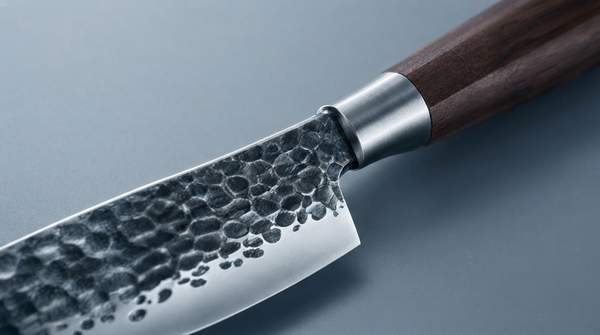
Here's the misconception worth killing before you spend money: Damascus is not a type of cutting steel. Modern kitchen Damascus is a construction technique — layers of two different alloys forge-welded around a hard core, then etched so the higher-carbon layers turn dark and the low-carbon layers stay light, producing the wavy contrast on the blade's face. As one knife guide summarizes it bluntly: the waves are the face, the core is the knife.
That means a "67-layer Damascus" chef's knife cuts exactly as well as its core steel — a VG-10-core Damascus knife performs like VG-10. The cladding isn't useless: it can add some lateral toughness around a hard core, and the textured face can help food release. But when you're comparing knives, ignore the layer count and read the core specification. Buy Damascus for a look you'll keep dry and a named core you actually want — never as a proxy for cutting performance.
Chef Knife Steel Comparison Table
The table below maps the common categories onto the four trade-off axes that matter at the cutting board, with typical hardness figures where the evidence supports them. The ratings are relative comparisons for home cooking, not laboratory scores.
| Steel Category | Typical HRC | Edge Life | Toughness (Chip Resistance) | Corrosion Resistance | Ease of Sharpening |
|---|---|---|---|---|---|
| VG-10 stainless | ~59–61 | Weeks of daily prep; a top-tier stainless performer | Good — rolls before it chips if you're not reckless | High; hand-wash and dry, never dishwasher | Cooperative on 1000-grit water stones; some skill helps |
| Powder steel (R2/SG2 type) | ~62–64 | Months if not abused; outstanding retention | Less forgiving — chips rather than rolls | High; still hand-wash | Slower; diamond abrasives help once the edge is gone |
| High-carbon stainless (workhorse) | Softer band | Shorter than VG-10, but a ceramic rod brings it back in seconds | Forgiving of daily prep and drops | High; the easy-care default | Easy on any decent stone or rod |
| 440C (budget named stainless) | ~58–60 | Behind VG-10, ahead of unnamed "mystery" steel | Good | High | Easy |
| Damascus cladding | Whatever the core is | The core's edge life | Cladding can add lateral toughness around a hard core | Two alloys — hand-wash or the pattern hazes | Sharpen the core as if it were mono-steel |
Read the table as a set of choices, not a ranking. The powder-steel row buys you the longest interval between sharpenings but demands a careful hand and patience at the stone. The workhorse row sacrifices edge life for a blade that refreshes in seconds and survives kitchen life. VG-10 sits in the middle as the balanced default, and 440C delivers a named, honest steel when budget is the constraint. The Damascus row tells you to look through the pattern to the core.
Choosing the Right Steel for Your Kitchen
Select a chef's knife with a steel type that aligns with your personal priorities for edge retention, toughness, corrosion resistance, and ease of sharpening, understanding that trade-offs are inherent — no category is objectively premium, and heat treatment and geometry can matter as much as the steel itself. If you sharpen rarely and cut carefully, powder steel rewards you with months of edge. If you hone often and want zero anxiety, the workhorse stainless keeps you sharp more often than a premium blade you're afraid to abuse. If you want one balanced knife, VG-10 is the sensible default.
The measurable indicator that you chose well is simple: the chosen knife consistently meets your expectations for sharpness, durability, and maintenance effort in daily use. If you're stropping or honing more often than you expected, or wincing every time the blade meets a bone, the trade-off you picked doesn't match your cooking — and the table tells you which direction to move next.