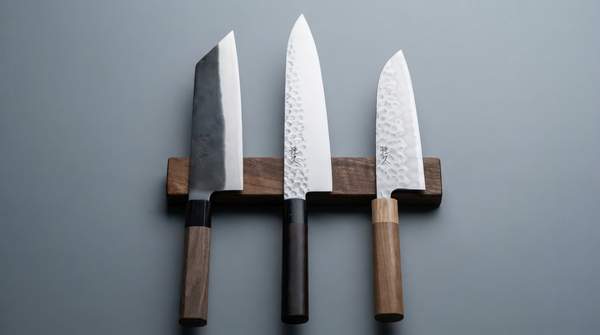
Choosing a Japanese chef's knife involves a fundamental trade-off between the blade's physical shape, which dictates its ideal cutting motion, and the type of steel it's made from, which determines its sharpness, durability, and maintenance needs. The best knife for you is one that aligns with your primary cooking tasks, your tolerance for upkeep, and how you value cutting performance. By understanding the interplay between blade geometry and steel composition, you can select a tool that feels like a natural extension of your hand in the kitchen.
The decision primarily breaks down into two questions. First, what do you cut most often? A tall, flat-edged Nakiri is a vegetable specialist, while the versatile Gyuto and Santoku serve as all-purpose workhorses. Second, what is your relationship with your tools? If you prefer low-maintenance equipment, stainless steel is an excellent choice. If you are an enthusiast who enjoys the ritual of maintenance for the reward of unparalleled sharpness, a traditional high-carbon steel blade may be for you. For those seeking the pinnacle of performance, modern powdered steels offer a compelling, albeit more costly, alternative.
Understanding Japanese Chef's Knife Geometries
While many shapes exist, Japanese cutlery often features specialized designs for specific tasks. The Nakiri is a prime example of a purpose-built knife, designed exclusively for preparing produce. According to knife resource Gyuto Club, a Nakiri is a tall, flat-edged vegetable knife intended for a straight up-and-down chopping motion. Its defining characteristic is a completely flat edge that makes full contact with the cutting board along its entire length. This ensures that vegetables are cut cleanly in a single push, preventing slices from remaining partially attached.
This specialization makes the Nakiri highly efficient for dicing onions, mincing herbs, and slicing through dense vegetables. However, it is not an all-around kitchen knife. The same source cautions that it is not meant for cutting meat or bone, and its flat profile is not suited for the rock-chopping motion many chefs use with more curved blades. Its design is a clear reflection of a philosophy where the tool's shape is optimized for a specific culinary function.
How Blade Geometry Influences Cutting Performance
Beyond the overall profile, the cross-section of a blade—often called its grind—is a critical factor in how a knife performs. According to the knife specialists at SharpEdge, a blade's geometry determines its efficiency, precision, and durability. This cross-section is a combination of surfaces, known as primary and secondary bevels, that taper down to form the cutting edge. The shape of this taper dictates the blade's thickness and strength, influencing everything from the pressure needed to make a cut to the way food releases from the blade's surface.
Blacksmiths carefully consider a knife's intended use and the properties of its steel when deciding on its geometry. A thicker, more robust cross-section might be chosen for a knife designed to cut through tougher foods, while a thinner, more delicate grind is suited for precise tasks. This geometry also affects maintenance. As a knife is sharpened over time, its profile can thicken near the edge. To maintain its original cutting performance, the blade must occasionally be thinned to restore its intended geometry, a process that reduces the effort needed to slice through food.