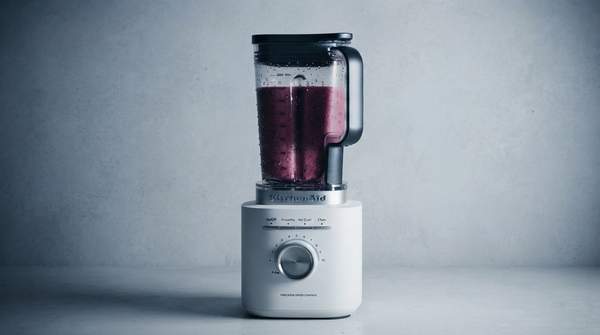
The number on the box tells you how much power a blender's motor can draw, not how well it will crush ice, smooth fibrous greens, or survive a busy kitchen. Tests across a wide sampling of blenders found that wattage has little correlation with real performance. The smarter approach is to work in the opposite direction of the spec sheet: start with the dishes you make most often, then choose a jar material for durability, heat, and stain behavior, and judge the motor as a complete system of blades, jar shape, and torque rather than a single figure.
Understanding Blender Power: Beyond the Watts
Manufacturers usually state motor speed in watts and occasionally in horsepower, with one horsepower equaling 746 watts. Most household models fall between 500 and 750 watts, though the market stretches from roughly 300 to 1,500. Higher-wattage machines typically cost more, which creates the impression that a bigger number buys a better blend—but testing reported by Consumer Search contradicts that theory, concluding that wattage alone predicts little about how a blender actually performs.
The reason is that a wattage figure describes potential, not delivery. A guide to blender power from The Hearthful Home puts it plainly: the power you need depends on the recipes and batch sizes you expect to handle, so you should compare the complete machine—motor rating, jar and blade design, controls—rather than one number. A pourable fruit drink, a spoonable frozen bowl, and a small herb sauce ask very different things of the same motor.
Horsepower claims deserve the same skepticism, with a specific caveat. KitchenAid distinguishes motor horsepower measured on laboratory equipment from the power actually delivered in the jar, and Blendtec describes its peak-horsepower figure as a laboratory result that includes the motor's inertial contribution—something separate from operation during use. When a listing leads with a peak claim, look for the definition and test conditions behind it rather than treating every peak number as the same measurement.
What separates efficient machines from loud ones is the vortex. A well-engineered system with moderate power can create a cyclonic action that pulls ingredients down into the blades naturally, so energy transfers efficiently to the food. That reduces strain on the motor and extends the appliance's lifespan. When comparing models, look for descriptions of specific blade angles and jar design rather than peak horsepower alone.