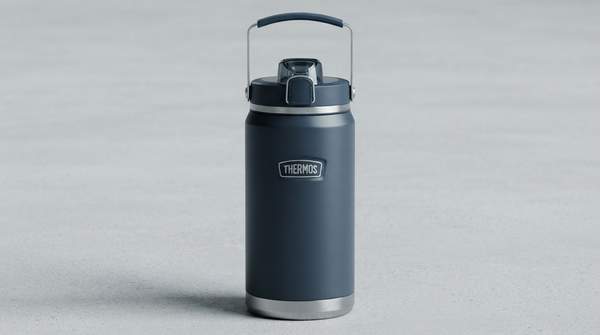
Vacuum insulation wins on temperature retention, and the reason is physics: by removing the air between a bottle's two steel walls, it nearly eliminates the two dominant ways heat leaks in or out. Foam insulation, which fills that gap with a material full of trapped air pockets, slows heat transfer but cannot stop it. The practical consequence is a clear split: vacuum-insulated vessels are built for all-day temperature stability, while foam-insulated ones suit short trips and casual use. Here is how each technology works, how they compare, and how to choose.
How Vacuum Insulation Works
Heat is constantly trying to equalize — moving from warmer areas to cooler ones. As the Thermos Brand's own explainer on the science behind its products puts it, heat "does this in three distinct ways," and a well-engineered bottle must address all of them simultaneously. Understanding those three modes is the key to understanding why a vacuum works so well.
The first is conduction: heat travels through direct contact between materials. Touch a hot pan and heat conducts through the metal into your hand. In a single-wall stainless steel bottle, heat conducts from the warm exterior through the metal wall directly into your cold drink — warming it within an hour or two. The second is convection: heat transfers through the movement of a fluid or gas, so warm air circulating around a container steadily carries heat away from it or toward it. The third is radiation, in which heat moves as infrared energy even across empty space.
A vacuum-insulated bottle attacks all three at once with a double-wall structure. The manufacturer removes the air from the space between two steel walls, creating an airless gap. With no air molecules present, there is nothing to conduct heat between the walls and no gas to circulate and convect it. As thermal-performance data compiled on PatSnap's Eureka platform explains, the absence of air molecules means conduction and convection are minimized, which is what makes vacuum insulation so efficient. The reflective steel surfaces further limit radiative transfer. The result, according to that data, is a vessel that can keep beverages hot or cold for extended periods, often ranging from 12 to 24 hours.